The one called Jeff awoke at 1:25, in the peëth of em, and spake to nobody in particular. "I would like nachos," Jeff said. Our Lord the One True Jeff went to the kitchen side of his studio apartment, and searched for chips and cheese. In that, the Age of Despair, and no chips nor any cheese were to be found. But this did not sway Jeff, for he had known hardship before. The path to Lucky's was long, and tough. Jeff wandered for many minutes, before finding a bus stop. "This is great," though Jeff. "Whoa." As they were not yet enlightened, the other travelers on the bus did not look upon Jeff. Lucky's welcomed Jeff, however, and he was able to find cheese and chips after only a mild struggle and a few onsets of plague. Truly, Jeff though, that was cool of them. It was but 2:40 in the Time of Our Jeff. He had not realized that, due to the Thanksgiving Holiday, the buses had stopped running at 2. This was to be the Dark Age of Jeff, the time of loss and wandering. For the path back from Lucky's was known to Jeff, but as it was dark, and as he was sad about being exiled, he became lost. Jeff wandered Colorado for 40 minutes and 40 more minutes. Hunger and desperation took hold, and he begun to question if he would get back in time to see "Survivor: Minneapolis". It was then, during his time of great sadness, that Jeff came upon a burning Subaru Outback. It tried to talk to him, and Jeff thought "Dang," and went to take a nap in a small grove. Jeff was poked, and hit about the knee with a long twig. He opened his eyes and saw a face peering down at him. "Dang," it said. This person, he who woke Jeff, would become known as Chad, the First Disciple. "What's up," Chad said. Chad drove Jeff home, and they watched "Survivor: Minneapolis" together while Jeff ate nachos. "This was great," Chat said. It was then that Jeff said "Yes." It was then that Chad began to tell others of Jeff; records still exist of the message he sent to Crissy, Knower of Chad. "wut up w u?", Chad's message said. It was there that the Gospel of Jeff According to Chad began, and this story ends.
Konchehaup
Preotoscuy

Cataphrunk

Acrassmas
Haoe
Pqorsl

Follow-up: Putting an Nvidia 670 in a Mac Pro
I returned the EVGA because it just wasn't worth the fuss, but then Nvidia started releasing their own OS X drivers, so I thought I'd give it another shot. I got another 670, an Asus DirectCU II, and tried it again.

The card uses a different style of cooler than the 5870 and EVGA 670 FTW, which I thought might help with the heat concerns. It also looks nifty!

Installation was totally normal, as usual. I didn't have issues with the EVGA in Slot 1, but someone was reporting trouble; as they're both x16, I figured I might as well put it in Slot 2 to get some cool air 'round the back anyway. Probably made no difference to temperature or stability. Whatever. It booted up just fine, and I installed the newest OS X drivers from Nvidia, as well as Asus' GPUTweak thing in Windows. That came with an older driver (301.something?), so I installed the newest 306 drivers on the Windows side.

So far, so good...

Luxmark is slightly worse than the EVGA.
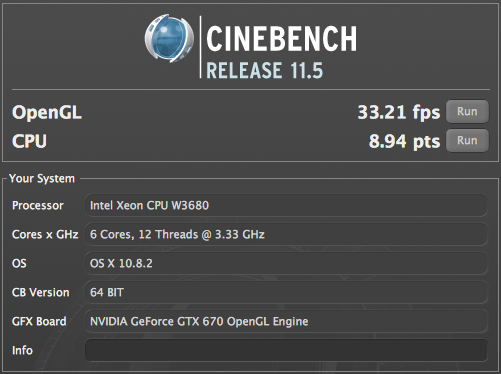
Cinebench is only marginally better than the EVGA, and still worse than the Apple 5870.
Games were the same. Most things are slightly faster than the 5870, Source games have a tiny bit of microstutter (but are just fine), Civ 5 still has numerous graphical glitches, and the wrapped version of Skyrim still sucks (plays beautifully under Windows, of course). I was hoping for an improvement to everything, with the new drivers from Nvidia, but an improvement to anything would have been nice. Long story short, there still isn't a worthwhile difference in game performance between the 5870 and 670 under Mac OS. Unless you only play WoW.
The card's non-reference cooler was fine. I put in some vented PCI slot covers (as the Asus blows up, not out, and I wanted some way for the hot air to escape), and that was that. The PCI bay fan ran faster, but temperatures were the same. The Asus was significantly quieter than the EVGA or the 5870. I didn't notice the rear hard drives (on which the Asus 670 exhausts) to get very hot; they reported about a 10°F increase over the 5870. The PCI fan must have been keeping most of the air off 'em.
The real problems are in Windows. Asus' software is kind of crappy, but functional. Most games were great — Skyrim, New Vegas, and so on — but World of Tanks had really horrible microstuttering, regardless of AA, V-sync, or any other graphics settings in the game or Nvidia's control panel. Hours and hours of screwing with settings, driver versions, and so on later, I pulled the goddamn thing out and threw the 5870 back in. Given how few reports of the problem there are, I expect it's some arcane conflict with Apple's Boot Camp drivers. Maybe I'll try again this afternoon, or maybe I'll just return it and use the $400 to go on a nice trip somewhere with R. Monkeys. It is to some degree worth all the crap (dang, Skyrim looked nice), but the point at which it isn't approaches fairly rapidly.
Edit: Solved! Hardware fault, according to ASUS. Exchanged 670 for another EVGA FTW — works fine. Done!
Huset, Apiologist Extraordinaire
A list of French Avant-Garde filmmakers whose works you are now familiar with: Serge Manadar Born in Tangier, Morocco, Manadar rose to preeminence in the genre following the 1976 release of his third film "La souffrance est la sufferance", the plot of which concerned the nameless, faceless narrator's attempt to come to grips with the failure of his uncle's career in NASCAR. Manadar continued to crap out highly-regarded work throughout the '70s and '80s, culminating in his Golden Buttflap award at the 1987 Zurich Film-Liebhaberpartei for "J'avais l'habitude d'être un personne", which charted the growth of several shrubs native to the Uzbek steppes, and juxtaposed that with sexual assault. Manadar continues to make short films under a rotating series of assumed names, but due to his expulsion from the Film Ligue de Napoléon (who were jealous of his France-wide success), he is unable to release his films in a format viewable by bipeds. Unknown to most, Jacques-Yves Cousteau was merely one of Manadar's disguises. Christodou "U" Breziere Breziere's work first began appearing in cinemathequeopolitronesses in 1973, when he attained instant fame for "Je ne suis pas celui qui respire", an animated snuff film in which a protagonist named for Breziere attempts to acknowledge his fascination with pinching womens' noses. The work was shown to over 40,000 people each day, and a still from the film remains on the city flag of Moche-Metz, in the Rhône valley. The bulk of Breziere's subsequent work is composed of a series of grouchy reminiscences on the transient popularity of the Avant-Garde filmmaker, the most notable of which is 1979's "Salauds! Pourquoi ne pas regarder mes films?" Breziere has since retired, and lives with his robotic fiancée Robertiñho in a houseboat on the Charente. Michel Wallenhuis The Belgian émigré's first film, 1977's "Regardez mon cul, pleurnichards", was notable for being the first film to depict an overweight, irate man's existential suffering. The manner in which it did so, by having the protagonist scream bizarrely-specific insults at the camera for six hours, resulted in immense critical praise for Wallenhuis, but the film met with limited commercial success. "I made ten francs from the entire fucking thing", he claimed in a 1994 interview with "Belgian Losers", a program on Nederlandse Publieke Omroep's Radio 5. Wallenhuis quit the film business after failing to secure funding for any further projects, and spent the '80s and '90s as a bookkeeper specializing in bets on the success or failure of the Russian Mir space station. His current whereabouts are unknown. Un clone de Serge Manadar Popularly known as "Un Clone," Un clone de Serge Manadar was the result of a French government project to encourage the adoption of French culture in Algeria in the years following that country's independence. Un Clone was a direct clone of Serge Manadar, and, with the backing of the Ministère de la Culture, produced a staggering amount of films in the late '70s, including "J'ai peur de Pierre", "L'ennui morne matin", and "Donc, très solitaire, dans cette foul". However, the cloning process was imperfect, and cellular degradation began to take hold. Un Clone's final films ("Me regarder dissoudre" and "Sexe avec le cadavre de Georges Pompidou") have been written off as confusing and literalist. Un Clone dissolved on March 23rd, 1980. Alain Barbé-Marbois The reclusive director of "Je suis triste du coude" had a troubled childhood in Paris' 7400th Arrondissement, before escaping in a barley train to join a traveling accounting firm (a journey detailed in 1973's "La douleur est le seul bonheur"). He was a well-regarded accountant on film and television productions, but longed to direct. After stealing several cameras, lenses, and actors from one of "U" Breziere's productions, Barbé-Marbois made a string of filmotropic maladies that were released straight to shadow puppet reenactors before finding success with 1975's "Merde est le ciel, merde est mon coeur", the unexpected sensation of the year's award shows. Barbé-Marbois, finding that success had made him money, immediately burned all his film stock, and declared that he would, from that point, "only do unpopular things, like murder, or fiscal irregularities". Depressed by the contemplation of success, Barbé-Marbois' last moment of notability was a defection into East Germany, where he achieved recognition in the country's literary underground for his publication of "Meine Traurigkeit ist Komplette", a novel that could only be read while submerged in mineral oil.
The 2065s Are In